In Jingfu it is thirty milligrams, listed as Siberian ginseng: resilience for the long ones. Between damiana and arginine. The acute formula, not the daily one. Qifu keeps true Panax. This is the other Araliaceae, the one the Soviets reached for when the real root ran short.
A Far Eastern shrub, then a laboratory word
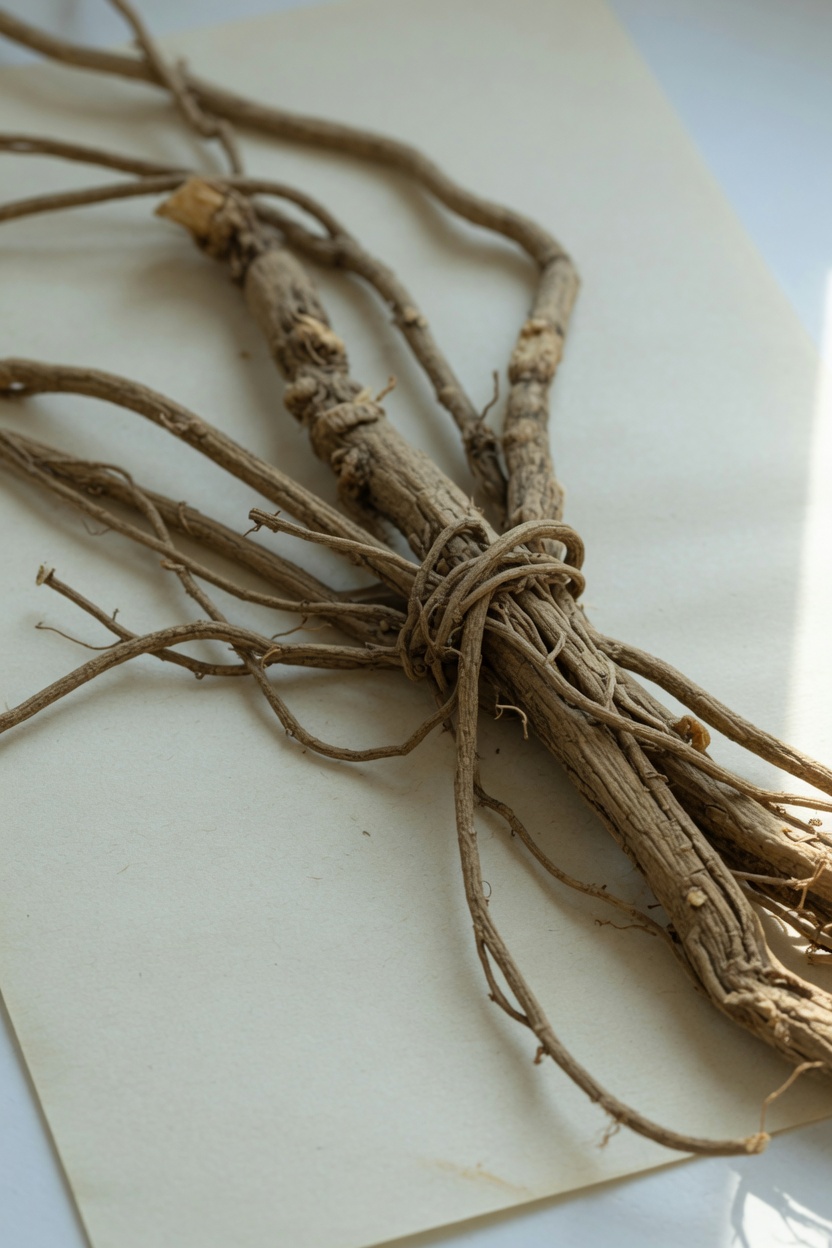
Chinese medicine knows it as ciwujia, Acanthopanax senticosus. The Nanai hunters of the Russian Far East used the berries and seeds against thirst, hunger and exhaustion, and to see at night. That is the older, local use. The global one starts later.
True ginseng takes six years and was already scarce in the Soviet Far East by the 1950s. At Vladivostok, I. I. Brekhman screened the ginseng family for a stand-in that would grow in quantity. Eleuthero was the one that grew on Soviet ground. N. V. Lazarev had just coined adaptogen: a substance that raises non-specific resistance. The word is 1958. The shrub is older. The pharmacopoeia of the USSR listed the root in 1962. Cosmonauts, athletes, the cold. A state project laid over a forest plant.
What we keep
We do not need the Cold War to keep the shrub. We also do not call it ginseng except where the spec already has. Eleuthero is the honest name. Thirty milligrams in an acute sachet is a small, practical dose for resilience, not a programme for orbit.
Araliaceae, with ivy and with Panax. The compounds later named eleutherosides are why the papers keep returning. Jingfu asks the root to sit with muira puama and catuaba for the hour. Different forest. Same brief: last the evening.
Why it sits in Jingfu
The acute line needs a plant for the long ones inside a short ritual. Panax is already in Qifu, where it can accumulate. Eleuthero is the cousin that works on the day. The substitute, kept because it is itself.
This journal will keep one plate at a time. History first. The formula second. Claims last, and only the ones we can stand behind.
End of plate IX. End of Volume I.