
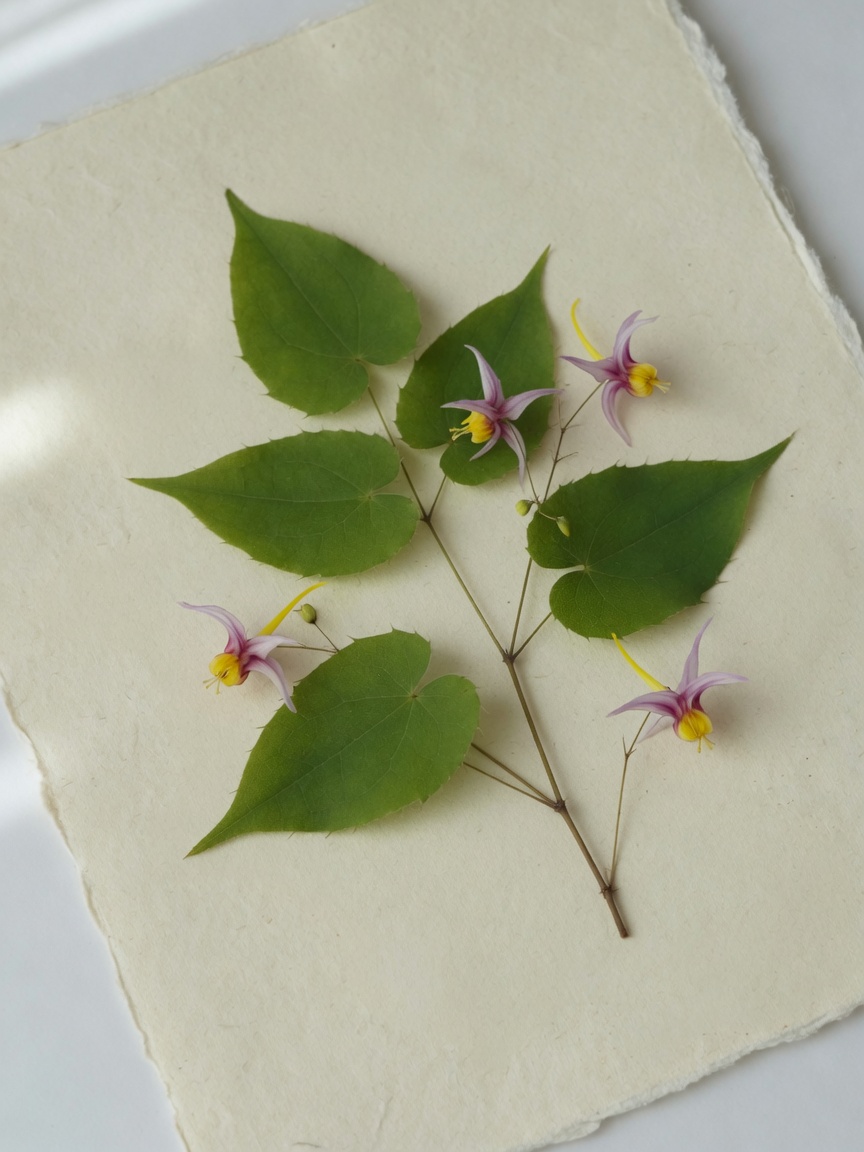
In Changfu it is the lead: five hundred milligrams of Epimedium extract, standardised to twenty per cent icariin. Quanfu carries the same. Barrenwort to English gardeners, yin yang huo to the Chinese books, horny goat weed to everyone who has read a label.
A goatherd's story
Yin yang huo is usually glossed as the lustful goat's herb. The story that travels with it is a herder who noticed his flock grew restless after grazing a certain leaf. It is a story, not a trial. The plant is older than the telling. It sits in the Shennong Bencao Jing, the Divine Farmer's materia medica of the Han, among the herbs for the kidney, which in that tradition holds a man's vitality.
From the border to the bench
Europe met it as an ornamental. Nineteenth-century collectors brought epimediums west for shady borders, and gardeners still call them barrenwort, which is the opposite reputation entirely. The laboratory arrived late. The compound it named is icariin, and in the test tube icariin slows PDE5, the same enzyme the prescription tablets block, only far more weakly.
Berberidaceae, with barberry. Icariin is a flavonoid, and most of what is known about it comes from cells and rats. The human trials are small. It should not be combined with blood pressure medication, blood thinners or prescription erection tablets without a doctor's say.
Why it leads Changfu
Changfu is for flow and staying power. Arginine in the base feeds nitric oxide at the top of the pathway. Icariin works further down it. Two ends of the same sentence. If erections are a regular problem, the first stop is a GP, because those vessels are often the first to report on the heart.
This journal will keep one plate at a time. History first. The formula second. Claims last, and only the ones we can stand behind.
End of plate VIII.